


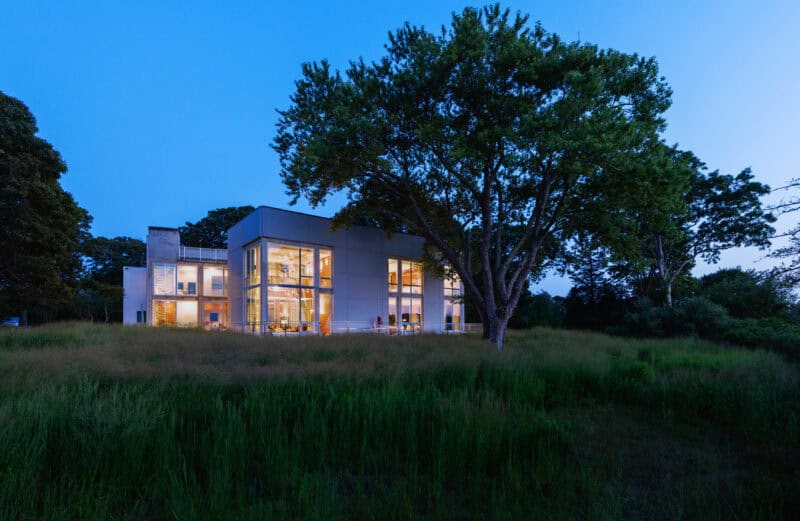
Architecture by Shelton Mindel in collaboration with Reed Morrison Architects; landscape design by RF Landscapes
Is a lawsuit a home’s ultimate status symbol? Ask architect Lee Mindel.
Text ISIAH MAGSINO
“What’s that dead bird on the fireplace mantle?” Lee Mindel asks in response to my question about how his sleek Hamptons spread landed him a lawsuit from a neighbor back in the late 2000s. When I tell him that it’s a taxidermy peacock bought from Creel and Gow, Mindel adjusts his glasses and sassily responds with: “You’re such an Upper East Side girl, I can tell! It’s totally messing up the proportions of your living room.” (I am, in fact, a boy, and did not ask for decorating advice.)
It’s a rather demonstrative way to start a video call with a total unknown, but Mindel is no stranger to speaking his mind, or causing a kerfuffle for that matter. The co-founder and partner of award-winning firm SheltonMindel, established in 1978 with the late Peter Shelton, has been unafraid to shake things up since he ditched any medical degree aspirations after his junior year at the University of Pennsylvania to join a similarly cult-like cohort. It was there, with the powerhouse coterie that taught and influenced the school’s highly regarded design programs (Louis Kahn, Robert Venturi, Bauhaus devotees, and, as Mindel described on the podcast The Grand Tourist, “the first generation of [Josef] Albers disciples”) that he found a home, and a new calling.
Fred Noyes, son of Eliot (one of the illustrious mid-century Harvard Five), was one of his teachers. “He was one of the most elegant men,” Mindel tells me. “I collect his tables.” (For architect buffs, these names are hallmarks of their world’s punk-rock group that forged a new mid-century look.)
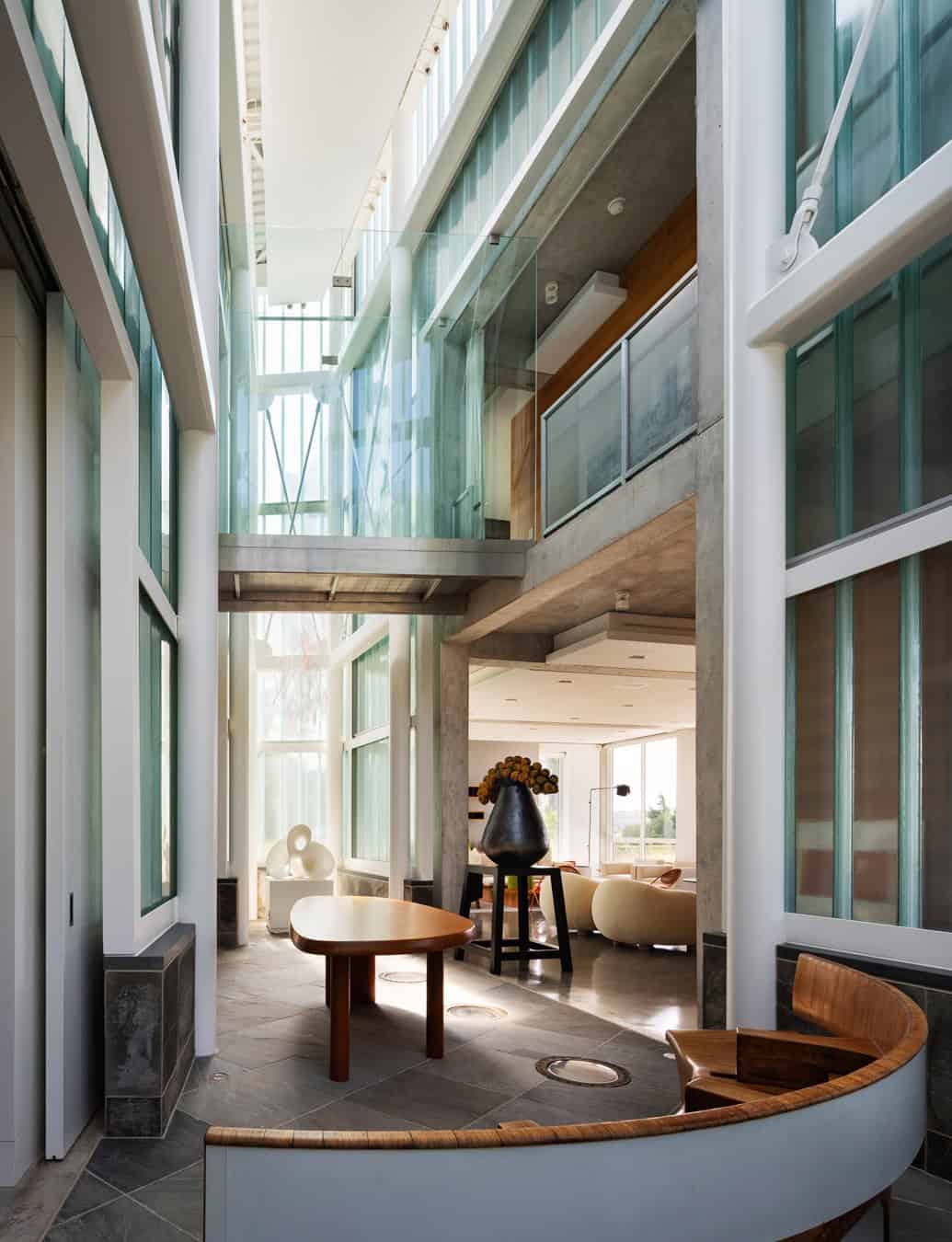
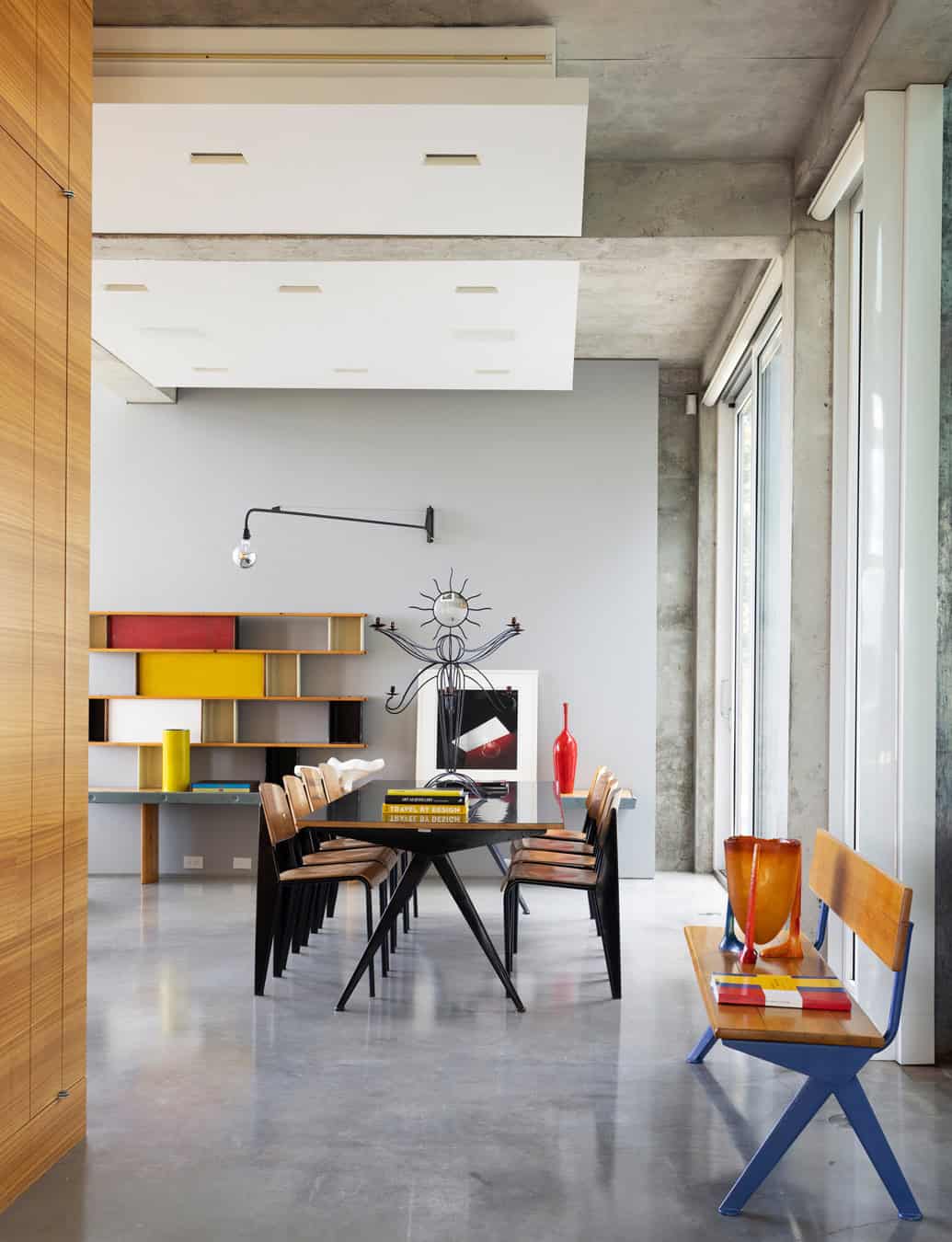
from left: From top: white sculpture by Eva Hild, 2005; Forme libre table by Charlotte Perriand, 1960; wooden curved bench by Charles Zublena, 1960s; The dining area features a Swing jib lamp by Jean Prouvé, 1952; Tre piede case by Gaetano Pesce, 2003; Tunisie bookcase by Charlotte Perriand, 1953
Today, Mindel is known for buildings drenched in sunlight and outfitted in elegant, clean lines championed by the aforementioned architectural styles. The Jenga building that punctuates TriBeCa’s gothic cast-iron skyline and appears to balance atop a sculpture by Anish Kapoor? That was done by Mindel in partnership with Herzog & de Meuron. The Ralph Lauren HQ that juxtaposes the brand’s signature moody dark wood interiors with fresh lightwood workspaces? His work, too.
Sure, Mindel’s debauched nights at Studio 54 score him cachet among those obsessed with a certain nostalgic New York milieu, but it’s his work as an architect that has landed him titles with design world gravitas: multi-time winner of the NYC x Design Awards and American Architecture Awards; as well as a member of the AD100 Hall of Fame, to name just a few. But some awards hit home more than others.
When it came to designing his own beach-front residence within the elite, sometimes homogenous, Hamptons enclaves in 2007, it’s no surprise that Mindel’s daring design choices caused a bit of stir with his soon-to-be neighbors. “People were very scared when I was doing it. They thought I was building a nursing home,” Mindel says with a chuckle. “It’s a concrete building, and nobody was building with concrete then. Everyone was mean to me. A neighbor sued me. I took down a tree from his scrubby oaks and he went crazy.”
But how times have changed. “And now I’m like the hero of the neighborhood,” he adds, “because it’s actually a very discreet home and you can barely see it from the water.” The home that Mindel designed in collaboration with his Harvard classmate Reed Morrison, won an award from the Chicago Athenaeum, as well as an NY Architectural Design Award.
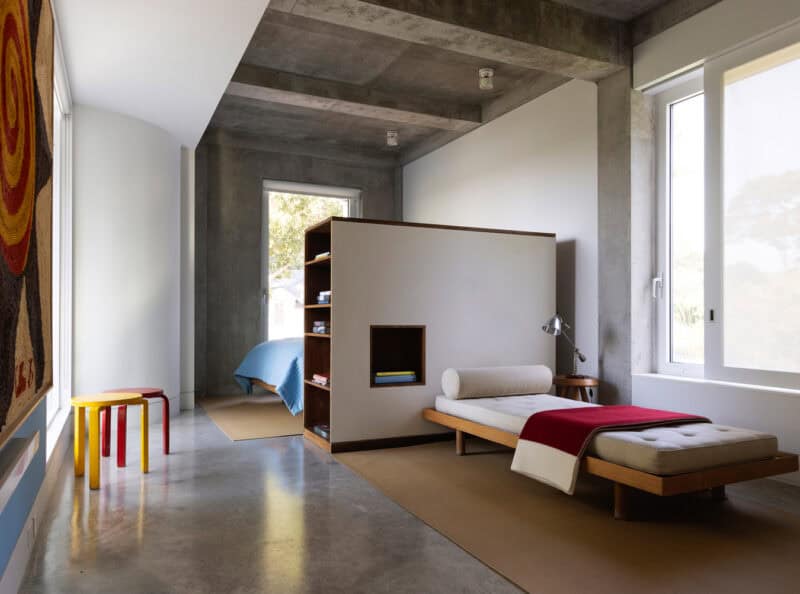
From left: Stool 60 by Alvar Aalto; room divider by Charlotte Perriand, Le Corbusier and Lúcio Costa 1955-59; Maison du Brésil bed by Charlotte Perriand 1959
To be fair to Mindel’s opposition, the home doesn’t exactly blend in with the classic Hamptons shingle, colonial, or Greek revival styles that the area immediately conjures in the mind. Instead, it is, as he describes it, a “cracked egg,” whose north and south sides are made of concrete, but punctuated by a middle living space completely made of floor-to-ceiling glass (think of this as the yolk). Both the south and north facades take a nearly rectangular shape, with the north facing directly to the ocean. The lush surrounding yards, meanwhile, were done by RF Landscape Architecture. There is, however, a quality reminiscent of classic Hampton’s architecture that his neighbors may one day come to peace with. The ‘shells’ of the home are outfitted with a layer of cedarwood curtain walls that open and close, allowing for more light to filter in when he so chooses. In that way, they look like the sexier, sleeker version of the neighboring facades.
Inside, meanwhile, is a treasure trove of 20th-century design goodies. A 1960s wooden curved bench by Italian designer Charles Zublena offers an elegant landing within the home’s glass middle. Mindel grounds the dining room with classic chairs and a table by the French designer Jean Prouvé, dating to the 1950s, while a 1953 Tunisie bookcase by Charlotte Perriand adds color and verve to the room with its yellow and red painted shelves.
“I actually don’t think modern principles of design are different from any design principles of any era,” he says. “It’s all based on the principles of solving problems. The solutions depend on the appropriate context and appropriate materials that respond to the space. Form follows function.”
So, why not erect a home that appears to follow the footsteps of those in the neighborhood that came before him and save himself the trouble? “Why would you copy something?” he counters. It’s cheesy.”
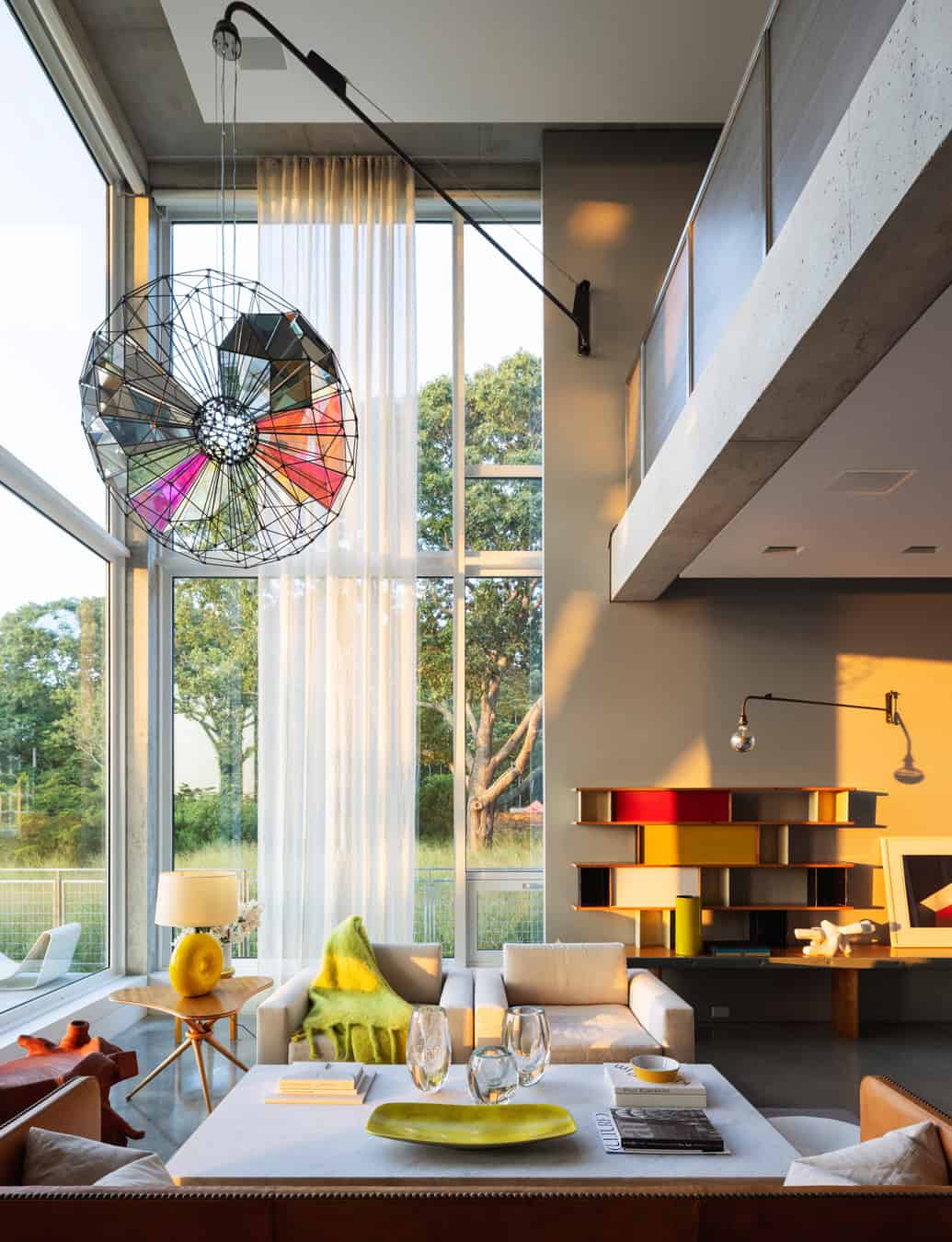
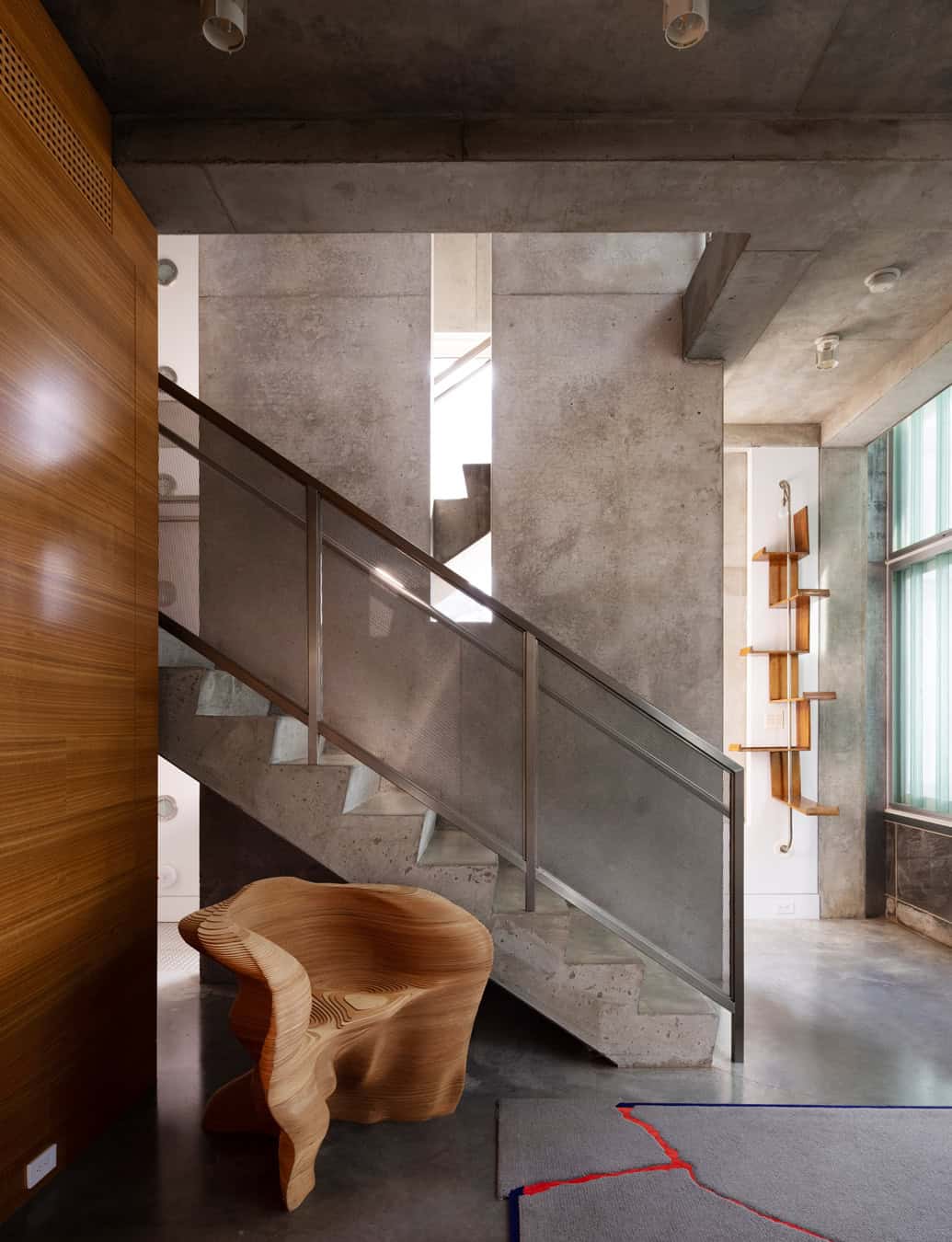
Furnishings inside the Hamptons house include a square sphere hanging light by Olafur Eliasson, 2007; occasional table by Peder Moos, 1948; a PK 63 coffee table by Poul Kjaerholm, 1968; From left: Slice chair by Mathias Bengtsson, 1999; Crack rug by Shelton Mindel for V’Soske, 1986
Mindel does admit that there’s a bit of an edge to living in a home of this ilk. “The home connects itself to nature and that, in itself, is an homage to the Hamptons. The home celebrates the Hamptons’ light, which always appears painterly because of the amount of vapor and volume,” he says. “It not only focuses on the ocean view, but also the site plan, which won a National Landscape Award. It delivers a collage of views of the surrounding area, including the garden view. Some say that Hamptons homes only focus on the ocean, but I disagree. The view is the whole surrounding environment.” To live here is to surrender to the natural elements.
Often, the first question homeowners are asked is what changes they’ve made to a property. But Mindel turns that question on its head, instead reflecting on how a home like this has changed him. “Lots of vacuuming. You get nutty,” he says. “You become an employee of it because you’re so committed to it. But with the seasons, you see constant change. It’s a miracle to me that these things happen. Why do they happen? It’s an existential question. To see change is a miracle. You have to listen it’s stronger than you’ll ever be.”
It’s a similar sentiment shared by the aforementioned Harvard Five – Philip Johnson, John Johansen, Marcel Breuer, Landis Gores, and Eliot Noyes. In the 1950s and ’60s, the group of architects took to the then-rural land in New Canaan, Connecticut, to build out their ambitious designs. Many of those who lived there revolted. The papers called the homes “tissue boxes.” Today, they are revered.
Years ago, Mindel gave a talk at the Dallas Architecture Forum and began sounding off on great designers and their one-line philosophies, which have permeated throughout each of his projects. He quoted Leonardo da Vinci’s “Simplicity is the ultimate sophistication.” As well as Charles-Édouard Jeanneret, aka Le Corbusier’s, “Space, light, and order are the three things men need just as much as they need bread and a place to sleep.”
When asked what his one-liner would be, Mindel quickly says: “Style is the penmanship of thought.”

Photographer MICHAEL MORAN
His background of photographing album and magazine covers, helping with branding projects for Skims (amusingly, he took a series of photos for Kim K’s 2017 Christmas card) and creating 360-degree concert experiences for Ye and Gaga explain this expansive approach. ERL is all part of his boundary-less, all- encompassing project that gets larger and harder to define with each passing day. It’s also, of course, a bit of world-building that is the nature of a control freak. Even when styling and photographing his own look books, he opts for shooting inside, where he can exactingly manage the light, thereby eschewing LA’s infamously evocative golden glow. “There are too many factors when you shoot outside,” he said. “I like being able to paint the situation and subjects the way I want.”
I wonder how not studying fashion design has affected his approach. “I mean, it informs it by me not thinking about it at all,” he says after a pause. “I never think about it. I just make things I want to make. It’s not more complicated than that. And then I work on a piece until it feels authentic to me and feels like it belongs in the world.”
Lately, Linnetz has been leaning slightly toward more tailored looks, but done his way, in oversized silhouettes (“Oscar Isaac’s Huge-Ass Trousers Are a Sight to Behold” was a GQ headline about a look he made for the actor). And he’s been creating custom ensembles, like a webby, deconstructed dress for Cynthia Erivo (who also wore a swaggy, iridescent black silk taffeta suit from the ready-to-wear collection), or Jeff Goldblum in a tuxedo-inspired look crafted from nylon and topped with a sleek puffer.
“It’s rewarding, it fills me up seeing those moments,” he says of those designs, which often come from a personal relationship with the celebrity or stylist. “Those moments make it worth it for me,” he says, remembering meeting Erivo and finding her energy intense, but forging an instant connection (as a theatre lover, he was especially excited to meet her). “It feels real. It feels like an exchange of artists, and it was an honor that she wanted to wear that.”
Next up for Linnetz is a film project that he wrote and will direct. Details are scarce, but he’s pulling together a cast and hopes to film it this year. Speaking with Linnetz, with his calm energy and laid back California vibe, it can be hard to remember how big his world actually is, how large his ambitions are.
“I feel like all the things I lied about when I was younger came true,” he says. “I’d always tell people, ‘I’m doing this,’ or ‘I’m making a movie,’ or ‘I have a clothing line.’ I exaggerated the hell out of everything I was doing and now I’m literally living the lies I told, but in the best way possible.”
Talk to him long enough and you may find that Linnetz’s sweet facade hides a drive and focus that we’re just seeing the beginning of. “I’m always looking in the future,” he says. “I feel like people think I’m obsessed with nostalgia, but I’m actually more interested in innovation and futurism. I never like to think about where I am now. I’m always looking towards the future. I feel like I haven’t even done one percent of the things I want to do.”
Taken from 10 Men USA Issue 1 – CLASSIC, NOSTALGIA, CRAFT – out April 4th! Order your copy here.
THE CRACKED EGG
Instagram: @sheltonmindel / @leemindel
Photographer SCOTT FRANCIS
Text ISIAH MAGSINO


